

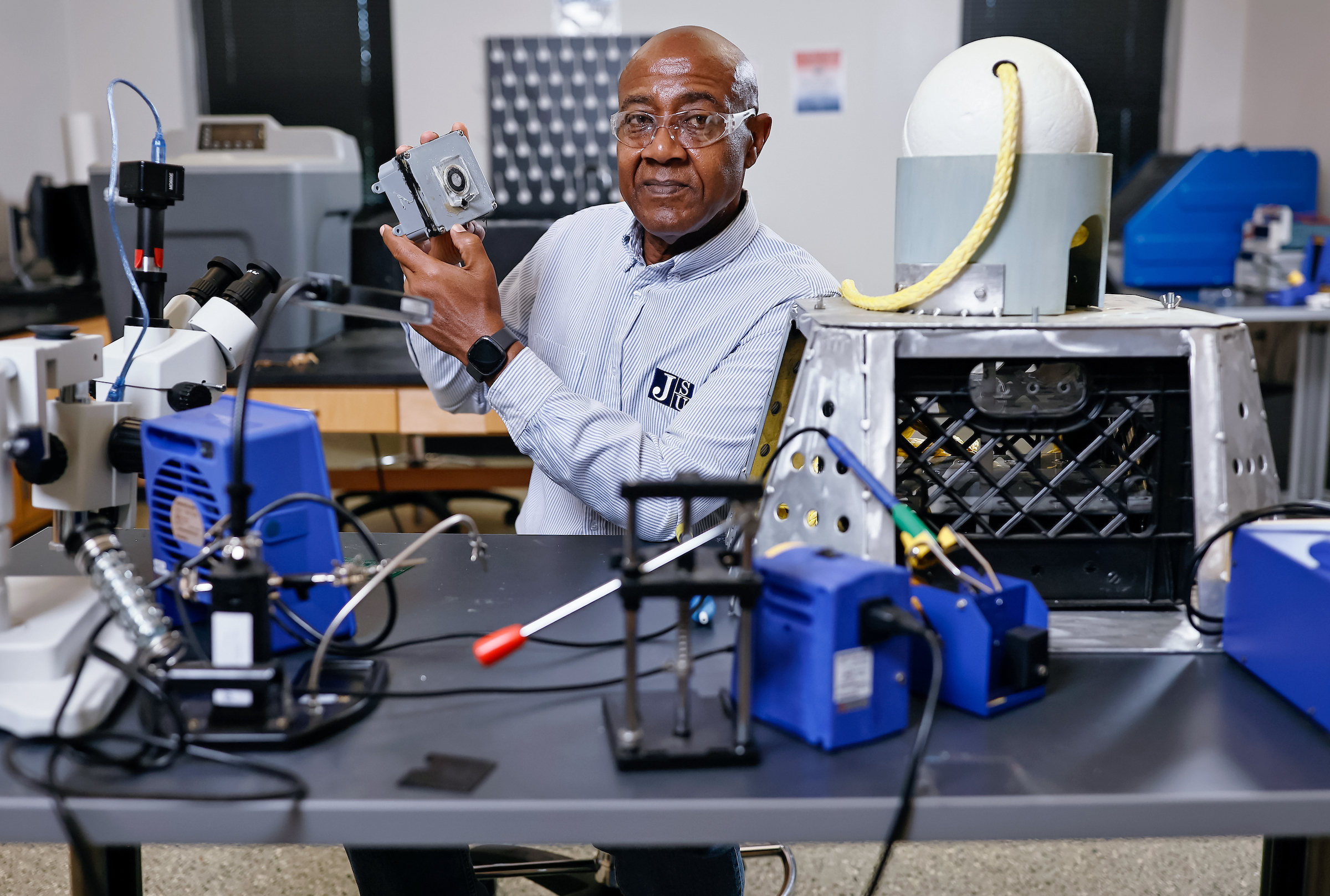
Device Designed to Protect Scientific Equipment and Aid Recovery
By Tangelia Kelly, Ph.D.
(JACKSON, Miss.) – Jackson State University (JSU) has been awarded U.S. Patent No. 12,246,800 for a groundbreaking underwater retrieval device that enhances scientific data collection while minimizing the risk of equipment loss or tampering.
The patented invention, titled Releasable Float Assembly and Method of Operating, was developed by Kamal Ali, Ph.D., professor of electrical and computer engineering. It is a fully sealed, smartphone-programmable system that allows researchers to schedule the retrieval of submerged equipment without leaving any visible surface markers. A float remains magnetically secured underwater and surfaces only at the designated time, triggered by a Bluetooth-enabled microcontroller. This design keeps research tools hidden from view and supports extended fieldwork in marine, coastal or environmental settings.
“Innovation is essential to the future of scientific discovery, and this achievement shows how JSU researchers are creating practical solutions with global applications,” said Almesha Campbell, Ph.D., vice president for research and economic development. “This patent protects the university’s intellectual property and opens the door for commercialization opportunities that benefit industry and society.”
Co-inventors include fellow JSU faculty member Ali Abu-El Humos, Ph.D., and graduate students James C. Addy, Michael P. Cameron, and Md Mohiuddin Hasan. The invention represents a significant milestone in JSU’s research enterprise and reflects the institution’s investment in student-centered, faculty-led innovation.
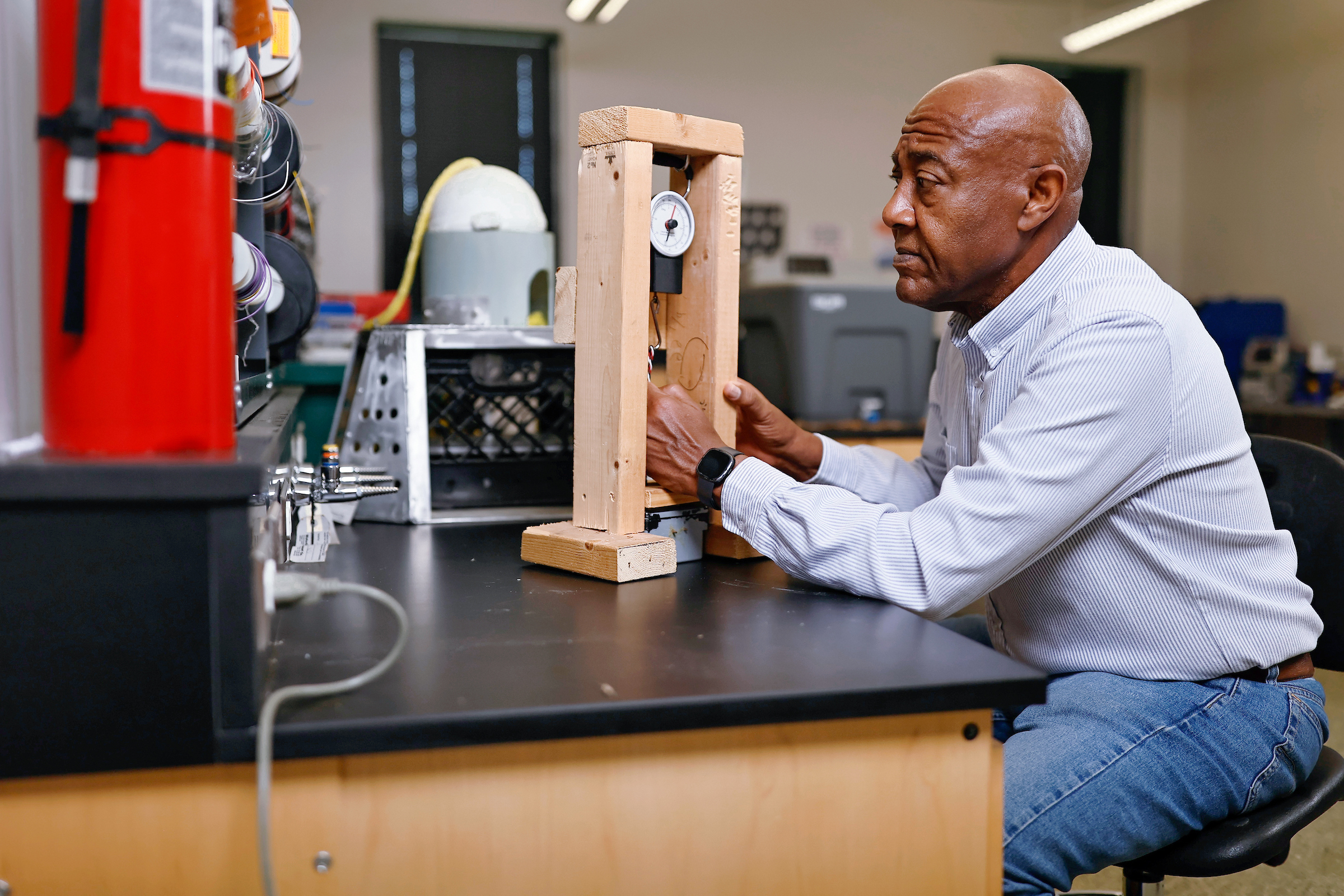
The Underwater Magnetic Release (UMR) System, operated via smartphone and controlled by a microcontroller, releases a float on a programmable schedule, ranging from minutes to months after deployment. Once activated, the float surfaces, pinpointing the equipment’s location for retrieval. This feature is especially valuable for marine science and environmental monitoring researchers, including those involved in the Mississippi Based RESTORE Act Center of Excellence (MBRACE) project.
The UMR is built with safeguards that support long-term use. It includes a sealed charging system and a magnet-triggered power switch that prevent shorts during underwater operation. Its low-power mode extends deployment time without compromising performance.
“This patent reflects the ingenuity and collaboration across our faculty and students,” said Ali. “The technology supports long-term underwater research while offering a secure, efficient, and reliable retrieval method. I’m proud to represent Jackson State as an innovator.”
Wilbur Walters, Ph.D., dean of the College of Science, Engineering and Technology, praised the work as a model of research excellence and mentorship.
“This marks a significant personal achievement for Ali and his team and shows what’s possible when faculty engage students in hands-on innovation,” Walters said. “We’re proud to see our students contributing to technologies with real-world relevance.”
Editor’s Note: JSU is currently pursuing commercial licensing opportunities for the UMR System. Unauthorized use of the patented technology without JSU’s written permission is prohibited under federal law.