

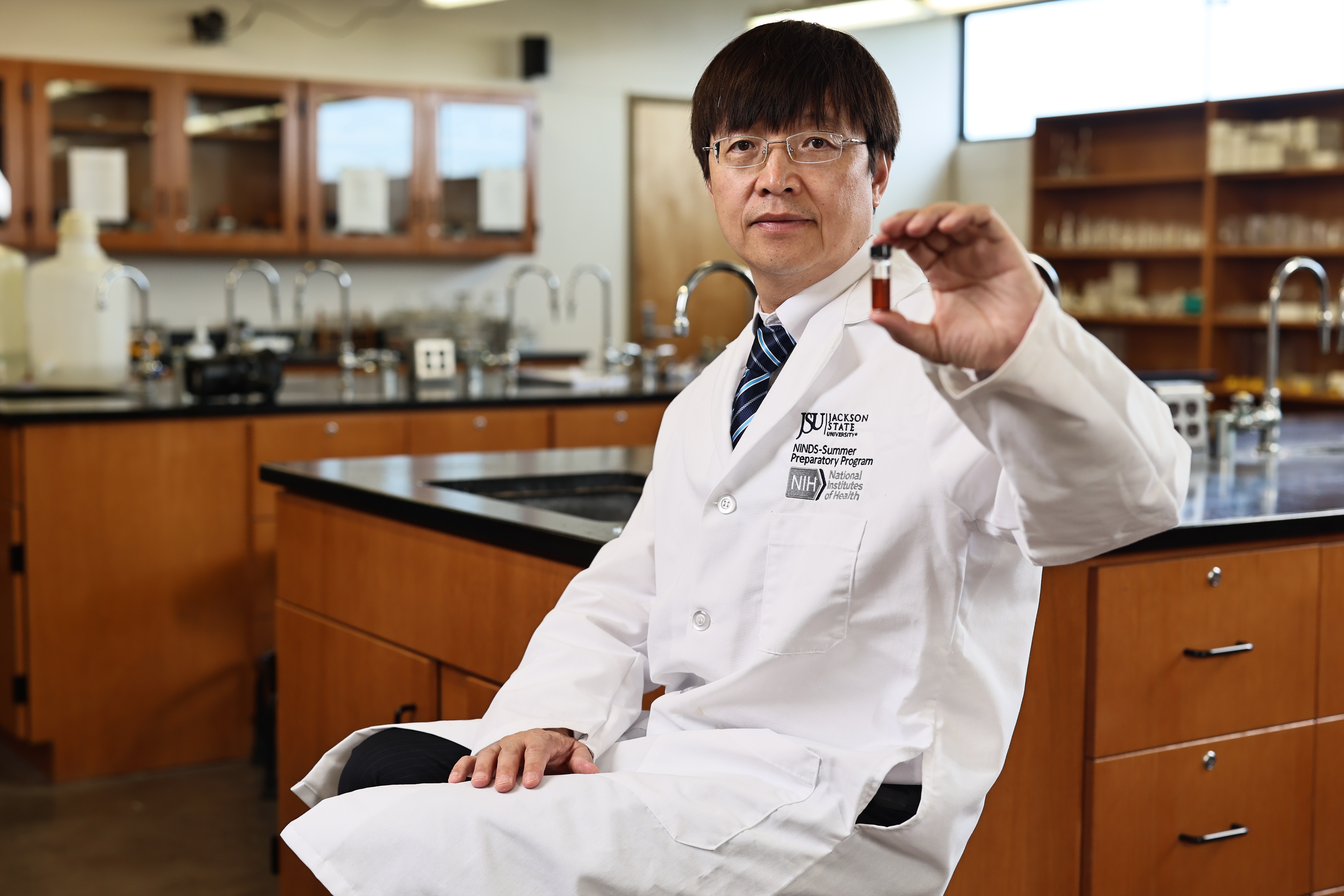
Patented method produces water-soluble magnetic nanomaterials
By Tangelia Kelly, Ph.D.
(JACKSON, Miss.) As part of this week’s celebration of Research Engagement Week, Jackson State University is recognizing its research teams and student inventors who have recently secured patents, grants or recognition for their inventions.
Today, the university is highlighting Yongfeng Zhao, Ph.D., associate chemistry professor in the Department of Chemistry, Physics and Atmospheric Science.
Last year, Zhao’s research led to Jackson State University being awarded U.S. Patent No. 12,404,184 for a method that produces water-soluble magnetic nanomaterials with controlled size, supporting research in biomedical imaging and related scientific applications.
The patent, filed in 2020 and issued in 2025, represents years of sustained research at the university focused on nanomaterials with real-world potential.
By enabling step-by-step growth of metal oxide nanoparticles, including iron oxide nanoparticles, the patented method allows precise size control while maintaining water solubility during medical imaging without additional surface modification.
“This work addresses a key challenge in nanomaterials research by improving their behavior in aqueous environments,” said Zhao. “By developing a method that ensures consistent size and enhanced stability, we are creating new opportunities to study and apply these materials in biomedical settings.”
Nanoparticles are widely used in biomedical research, but existing methods often limit control over size or require additional processing to make materials usable in water. These limitations can affect consistency and create challenges for researchers working in areas such as imaging and other applied settings.
“This achievement reflects the continued progress of our faculty and the strength of scientific research within our college,” said Wilbur Walters, Ph.D., dean of the College of Science, Engineering and Technology. “We are committed to supporting work that moves from discovery to protected intellectual property and contributes to meaningful advancements in the field.”
Zhao’s research is supported by the National Science Foundation, and the patent highlights JSU’s ongoing efforts to move discoveries from lab to market through its technology transfer process.
“This patent demonstrates how Jackson State University is advancing research beyond discovery to real-world impact,” said Almesha Campbell, Ph.D., vice president for research and economic development. “By protecting innovation, we are creating a clear pathway for continued development, commercialization, and meaningful application that delivers value to society.”
The research was supported by the National Science Foundation under grant HRD-1700390, and the federal government retains certain rights in the invention. Jackson State University will continue evaluating the technology for future research, pilot applications and commercialization pathways focused on real-world challenges.
For more information, contact technologytransfer@jsums.edu.