

By Mia Johnson
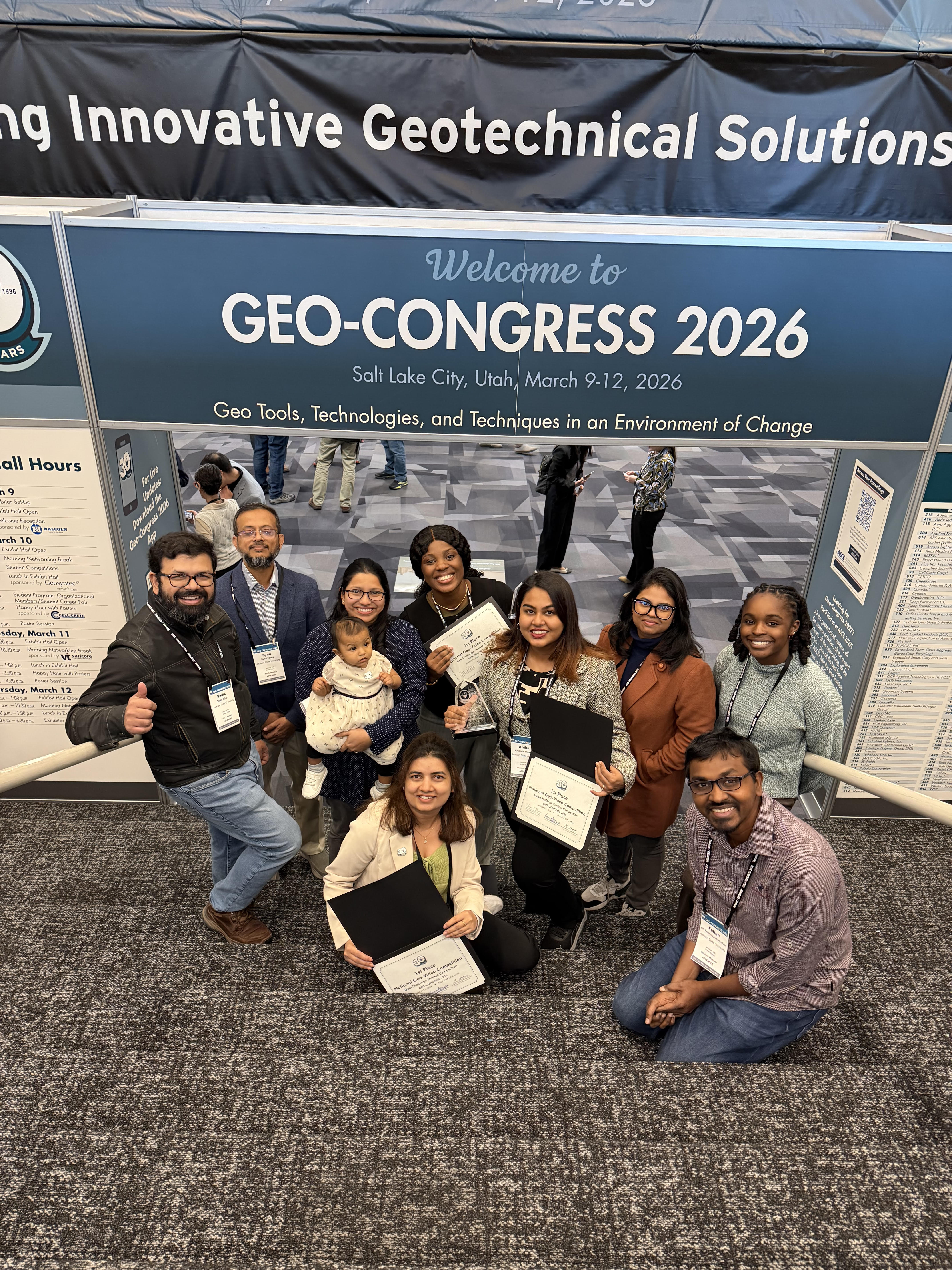
Jackson State University students from the Department of Civil and Environmental Engineering & Industrial Engineering and Technology recently earned first place in an explanatory video competition hosted by the Geo-Institute of the American Society of Civil Engineers.
The JSU team led by their professor, Sadik Khan, Ph.D., secured their win ahead of the University of Illinois (second place) and the University of Akron (third place) at Geo-Congress 2026 in Salt Lake City.
The students’ video, titled “What If Slopes Could Speak,” presents an innovative and engaging perspective on slope stability by bringing geotechnical processes to life through storytelling and visualization.
It shows how natural processes, such as rainfall infiltration, matric suction loss, and increasing pore water pressure, contribute to slope failure through a creative dialogue between a highway slope and a water droplet.
The students who created the video are all studying Civil Engineering, and the group comprises two Ph.D. students, Anika Mahzabin and Audrika Nahian; a master’s level student, Richa Pokhrel; and an undergraduate sophomore student, Akpevweoghene Diaso.
“We were inspired to participate because it gave us a chance to show how engineering can make a meaningful difference beyond the classroom,” said Nahian. “This competition allowed us to present our work in a way that is engaging, relatable, and impactful.”
A key concept of the video was the application of Physics-Informed Neural Networks (PINNs), which combine real-world data with fundamental soil mechanics principles to improve prediction accuracy. By embedding physical laws into machine learning models, the system enables early detection of slope instability and supports proactive decision-making.
This helps in traffic diversion, emergency response, and risk mitigation and also highlights the potential of combining geotechnical engineering, sensor technologies, and physics-based artificial intelligence to advance smarter and more resilient infrastructure systems.
Through an accessible and compelling format, the video project illustrates complex soil mechanics concepts and highlights the integration of advanced monitoring systems, including sensors, piezometers, and inclinometers, with artificial intelligence techniques.
“In our research, we study slopes as systems that are constantly responding to environmental change, but they can’t communicate what’s happening within them,” Nahian said. “That led us to ask – what if slopes could tell their own story?”
Nahian also emphasized the team’s goal of reaching younger audiences. “We wanted to connect with K-12 students who may not fully understand what engineering looks like. This was our way of making it more accessible and inspiring.”
“The biggest challenge was turning our idea into a clear visual story,” said Mahzabin. “We originally planned a stop-motion video using physical models, but weather conditions forced us to rethink our approach.”
The team ultimately transitioned to digital animation, using images and simple motion graphics to bring the story to life.
“Winning first place felt incredibly honorable and validated the hard work we put into this project,” said Pokhrel. “It showed us that we can compete and succeed on a national stage.”
Beyond the award, the experience has influenced how the team plans to approach future opportunities.
“This experience strengthened my appreciation for teamwork and showed me what we can accomplish when we work together,” said Diasco. “It also gave me more confidence in my technical skills and ability to communicate complex ideas.”